‘With or without India’: 15 member countries decide to sign RCEP on 13 March
Announcement made at ASEAN Economic Integration Forum in Bangkok. India decided against joining Regional Comprehensive Economic Partnership nearly a month ago.
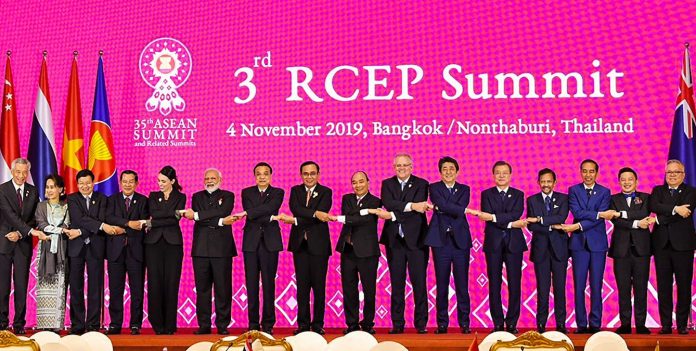
PM Narendra Modi in a group photo with other world leaders at the 3rd RCEP Summit in Bangkok, Thailand | PTI
Text Size:
New Delhi: Nearly a month after India decided against joining the Regional Comprehensive Economic Partnership (RCEP), the remaining 15 member countries Monday decided to sign the proposed free trade pact by 13 March, ThePrint has learnt.
The announcement was made at the ongoing 4th ASEAN (Association of Southeast Asian Nations) Economic Integration Forum in Bangkok.
“RCEP countries have decided to pen down the agreement on 13 March 2020 without India. The world’s largest trade bloc will emerge in the absence of India. India may join later once ready or continue with its regional and bilateral agreements with ASEAN and other RCEP members,” said a diplomatic source representing one of the member countries.
The Narendra Modi government has been informed about the signing of the trade deal but it has shown “no interest” in “working towards resolving the outstanding issues”, the source added.
The proposed free trade agreement is between 10 ASEAN member states (Brunei, Cambodia, Indonesia, Laos, Malaysia, Myanmar, the Philippines, Singapore, Thailand, and Vietnam) and their six free trade partners (China, India, South Korea, Japan, New Zealand and Australia). The member nations account for a third of the world’s gross domestic product (GDP) and nearly half of the world’s population.
According to another source, who is involved in the ongoing talks related to the pact, India has not come back to the negotiating table after it had decided to walk out of it.
Prime Minister Modi had on 4 November said no to RCEP at a summit held in Bangkok where leaders of the remaining 15 member countries gave their consent to formally sign the agreement by 2020.
At the time of opting out, Modi had promised that India will continue to discuss the pact, something which was later reiterated by Union minister Piyush Goyal too. In reality, however, New Delhi never went back to negotiating on it, said sources.
India also believes there is “nothing left to discuss” since the member countries already know what its demands from the trade pact are. If they agree to all of them, then New Delhi will sign the deal, a senior officer at the external affairs ministry said.
Home Minister Amit Shah had last month given a subtle warning to the RCEP member countries, saying they will have to come around to accepting India’s terms.
“Considering India’s growing stature, RCEP members can’t afford to ignore it for long, and will come around to agree to GoI’s terms. Meanwhile, India has maintained successful economic relations with ASEAN by the means of FTA,” he had said in an article.
India’s concerns with China and greater market access
One of the main demands that India had from RCEP is “significant market access” to other member nations. The fact that New Delhi has pulled out of the deal means it could not negotiate on a greater market access for its professionals, including engineers, doctors, journalists and IT workers, in member nations.
Some of the other concerns that remain unaddressed are inadequate protection against import surge, differences with China over pricing structure of goods, possible circumvention of rules of origin, keeping the base year as 2014 for tariff reduction, as well as no credible assurances on market access and non-tariff barriers, added sources.
India has also been facing stiff opposition from its industries and the farming community over the China-led RCEP and the over $60 billion trade deficit that New Delhi has with Beijing. The negotiations on the trade deal had started in 2012.
New Delhi: The Ministry of External Affairs has said the statement given by the US Commission on International Religious Freedom (USCIRF), an American federal body, on the Citizenship (Amendment) Bill is “neither accurate nor warranted”.
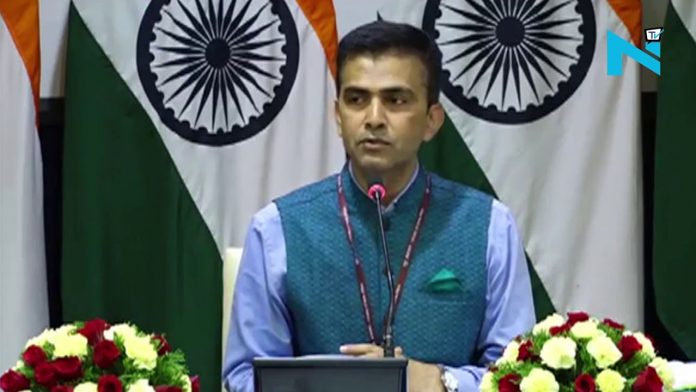
Responding to the commission’s statement that the US should impose sanctions on Home Minister Amit Shah and other leaders of the Narendra Modi government if the bill is passed by both houses of Parliament, MEA Official Spokesperson Raveesh Kumar said the USCIRF has “little knowledge and no locus standi” on the matter.
“The Bill provides expedited consideration for Indian citizenship to persecuted religious minorities already in India from certain contiguous countries,” Kumar said, adding it “seeks to address their current difficulties and meet their basic human rights.”
He said the initiative should be welcomed, and not criticised, “by those who are genuinely committed to religious freedom”.
Kumar also said the bill does not affect the existing avenues available to all communities who want to seek citizenship.
“The recent record of granting such citizenship would bear out the Government of India’s objectivity in that regard.”
He clarified that neither the CAB nor the National Register of Citizens (NRC) process seeks to strip any Indian citizen of any faith of citizenship.
“Suggestions to that effect are motivated and unjustified. Every nation, including the United States, has the right to enumerate and validate its citizenry, and to exercise this prerogative through various policies,” Kumar said.”
Stating that the USCIRF’s position is “not surprising given its past record”, the MEA said it is, however, “regrettable that the body has chosen to be guided only by its prejudices and biases on a matter on which it clearly has little knowledge and no locus standi”.
What the USCIRF had said
The USCIRF came down heavily on India hours after the bill was passed by the Lok Sabha around Monday midnight.
The federal body said it is “deeply troubled” by the fact that the Lok Sabha passed the Bill, adding that it is a “dangerous turn in the wrong direction” and completely opposite to “India’s rich history of secular pluralism and the Indian Constitution, which guarantees equality before the law regardless of faith”.
It also said it is concerned that the CAB along with National Register of Citizens (NRC) process in Assam and other states will “strip citizenship from millions of Muslims”.
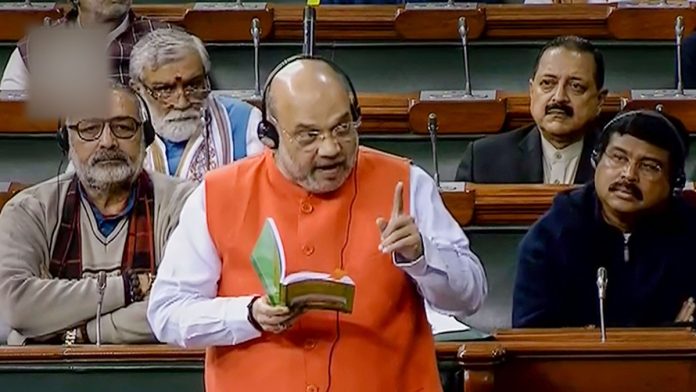
Home Minister Amit Shah speaks in the Lok Sabha while presenting the citizenship bill | PTI
Text Size:
Front page
After the contentious Citizenship Amendment Bill, 2019 (CAB), passed the Lok Sabha test, newspapers Wednesday focus on the bill in the Rajya Sabha, Shiv Sena’s changing stance and the widespread protests in the Northeast.
News is sparse on the ongoing Jharkhand assembly polls. Personal Data Protection Bill, 2019, and Supreme Court’s impending appointment of high court judges find mention in some newspapers.
CAB: In “CAB in RS today: Govt sure of numbers despite Sena U-turn, dissent in JD(U)”, The Indian Express sums up the Centre’s main concerns for the bill’s Rajya Sabha test. The Times of India echoes this in “Sena seeks answers before backing govt in RS, but NDA confident of numbers”, writing how Sena chief Uddhav Thackeray says his party needs “clarity on demands like denial of voting rights for 25 years to those gaining citizenship”. Hindustan Times is slightly more circumspect in its headline — “Sena makes U-turn on CAB but govt may have numbers”.
With images of protesters blocking roads with burning tyres, TOI reports on the unrest in the Northeast in “Violence rages in Assam over CAB, net suspended in Tripura”. The Hindu uses a similar image for “Violence mars protests against Citizenship Bill”, reporting on the “11-hour shutdown” against the passage of the CAB in the Northeast.
“Govt hits back as 2 US panels slam bill, NRC, calls for curbs”, reports TOI, while Express says “Undermines basic democratic tenet, says influence bipartisan US panel”. Express writes that according to the US House Foreign Affairs Committee, “religious pluralism” is central to the foundation of both India and the US, and hence a “religious test for citizenship” undermines that tenet.
SC judges: In “SC flags delay in appointment of judges”, Hindu reports how “two hundred and thirteen names recommended for appointment to various high courts and pending with the government/Supreme Court Collegium”. TOI focuses on the SC’s urgency— “SC: Centre must clear HC judge names in 6 months”.
Data bill: Express and HT have similar headlines for reports on the Personal Data Protection Bill, 2019, that will be deliberated upon in the Parliament Wednesday — “Govt agencies to get wide powers to call for personal data in privacy bill” (Express), “Bill may give govt a wider berth on data surveillance” (HT).
TOI frames it differently — “Agencies can snoop on personal data for national security: Bill”, adding activists feel the bill could “severely hit privacy”.
Others: “BHU Muslim prof quits, to teach Sankrit in another department”, reports HT with a straight headline. Express frames the development differently in “Hounded out, Sanskrit professor changes BHU post, students celebrate”.
Only HT (“We will form the next govt in Jharkhand, says JMM’s Soren”) briefly reports on the Jharkhand polls, writing that according to JMM president Hemant Soren “people in Jharkhand are determined to vote for change”.
Opinion
TOI: CAB passed the Lok Sabha with a ‘comfortable margin’, says TOI, however, the real test awaits in the Supreme Court where it will be challenged on the grounds of Articles 14 and 15, writes TOI. Home Minister Amit Shah said the bill meets the ‘reasonable classification’ threshold of exception, but it is to be seen whether judiciary passes it.
Shah’s argument that the article wasn’t necessary if the Congress had not accepted the partition on the basis of religion, may not hold weight as India was not created on the basis of religion, it states.
Hindu: People willed “instant reward and not punishment” for Karnataka lawmakers who defected from the Congress and the Janata Dal (Secular) to the BJP and sought a fresh mandate in recent by-elections, writes Hindu. The BJP, which had fallen short of a majority in the 2018 elections throwing up a hung legislature, now has 117 MLAs and a comfortable majority in the assembly.
Chief Minister B.S. Yediyurappa turned the resentment in the Congress camp to his advantage. Sixteen of those MLAs, who resigned, were promptly admitted to the BJP and 13 were fielded as its candidates. But the BJP was quick to own up its victory, it writes.
The BJP’s majority today has been won through a “devious route”. The problem is that there is now a Karnataka model of achieving a majority by engineering an adequate number of by-elections through highly questionable means, it says. The party must reflect on the cost to democracy this might entail, and focus more on governance in the state to reassure its commitment to democratic behavior.
Prime Time
Prime time was abuzz with the citizenship bill. On NDTV India, Ravish Kumar asked if the bill was a test of patience for Indian Muslims. Aaj Tak’s Rohit Sardana wondered, “Shranarthiyon ka samman ya Hindu-Musalman” (Respect for Refugees or Hindu-Muslim?). On NDTV24×7, Sreenivasan Jain questioned the link between CAB and the National Register of Citizens (NRC).
Zee News anchorsSachin Arora and Aman Chopra departed from the usual studio debate and visited Pakistani immigrants in New Delhi to find out what they thought of the bill. Seemingly in support of the bill, the anchors took the liberty to point at children on the streets to say, “This kid will get two meals a day, some clothes and education if this bill is implemented.”
The show was less a fact-finding mission and more a spectacle: The children were asked to chant ‘Gayatri Mantra’ by the anchors.
Political analyst Nishant Verma, who accompanied the anchors, observed, “Even though they are Hindus and living here for years, there was no law in place which was stopping them from getting an Indian citizenship”.
ABP News: Anchor Rubika Liyaquat, impressed by Amit Shah’s ability to convince the Parliament of the CAB’s merits single-handedly, declared, “Shah ka shandaar goal”.
She also debated Pakistan Prime Minister Imran Khan’s reaction where he described the bill as a “design of expansionism”. BJP’s Shahnawaz Hussain said, “Who is Imran Khan to speak about our internal matter. He should first care about Shias and Ahmadiyyas in his own country.”
IndiaToday: Rajdeep Sardesai asked whether CAB was a bid to polarise India and debated the historical facts of partition.
Sardesai told Congress MP Shashi Tharoor that Amit Shah had accused him of fear-mongering for his remark, “CAB is a victory of Jinnah over Gandhi and will turn India into a Hindutva Pakistan.”
Tharoor responded gamely: “The problem is that we don’t need to create fear. Fear is there in the eyes and minds of many, and not just Muslims. Hindus too.”
Sardesai then said that Shah claimed the BJP was trying to correct the wrongs of Congress as it was the latter that divided the country (partition) on religious grounds. To which, Tharoor retorted, “I don’t think he was paying attention in history class.”
BJP’s Gaurav Bhatia stood by the party, “The Congress promoted illegal immigrants coming into our country as they would later become their vote bank. What is happening today is in the interest of the country.”
CNN–News18: On #RightStand, Anand Narasimhan asked whether “the CAB push was fixing a historic wrong?’’
Author and RSS supporter Ratan Sharda said, “Someone said Hindus will benefit. I’m sorry but this bill is not brought to benefit any Hindu or Muslim of India, they are living very happily. It is for people who are being persecuted, who are real human beings.”
Ravi Shrivastava, political analyst, interrupted Sharda, “This is being done to create a vote bank for the BJP, it will not help the nation at all”.
To which, Sharda retorted, “Mr Ravi, do you have any business apart from heckling? Please don’t heckle next.”
ThePrint is now on Telegram. For the best reports & opinion on politics, governance and more, subscribe to ThePrint on Telegram.
NEW DELHI (Reuters) - India’s Hindu nationalist government on Wednesday won parliamentary approval for a far-reaching citizenship law that critics say undermines the country’s secular constitution by excluding Muslims.
Violence broke out in the ethnically diverse northeast while parliament debated the bill, as protesters against the legislation clashed with police.
It is the third key election promise that Prime Minister Narendra Modi’s government has delivered since he was re-elected in May, re-energising his nationalist, Hindu support base and drawing attention away from a slackening economy.
Soldiers were deployed in Tripura state and reinforcements put on standby in neighbouring Assam, both of which border Bangladesh, where people fear an influx of settlers.
ADVERTISEMENT
“The bill will take away our rights, language and culture with millions of Bangladeshis getting citizenship,” Gitimoni Dutta, a college student, said at a protest in Assam’s main city of Guwahati.
The Citizenship Amendment Bill seeks to protect besieged minorities in neighbouring states by granting Indian nationality to Buddhists, Christians, Hindus, Jains, Parsis and Sikhs who fled Afghanistan, Bangladesh and Pakistan before 2015.
The bill passed the upper house of parliament with 125 members supporting it and 105 opposing.
The move by Modi’s government faced stiff resistance from opposition parties, minority groups and student bodies.
Police use water cannon to disperse demonstrators during a protest against Citizenship Amendment Bill (CAB), that seeks to give citizenship to religious minorities persecuted in neighbouring Muslim countries, in Guwahati, India, December 11, 2019. REUTERS/Anuwar Hazarika
Despite assurances from India’s Home Minister Amit Shah that safeguards will be put in place, people in Assam and surrounding states fear that arriving settlers could increase competition for land and upset the region’s demographic balance.
Some opposition Muslim politicians have also argued that the bill targets their community, which numbers more than 170 million people and is by far India’s largest minority group.
The government has said the new law will be followed by a citizenship register that means Muslims must prove they were original residents of India and not refugees from these three countries, potentially rendering some of them stateless.
Members of other faiths listed in the new law, by contrast, have a clear path to citizenship.
“NARROW-MINDED”
ADVERTISEMENT
The U.S. Commission on International Religious Freedom said on Monday that Washington should consider sanctions against Shah, a close associate of Modi, if India adopts the legislation.
“The passage of the Citizenship Amendment Bill marks the victory of narrow-minded and bigoted forces over India’s pluralism,” said Sonia Gandhi, leader of the main opposition Congress party.
Defending the bill in the upper house, Shah said the new law only sought to help minorities persecuted in Muslim-majority countries contiguous with India.
“Nobody is taking citizenship away from India’s Muslims. This is a bill to give citizenship, not take citizenship away,” Shah said.
In another move criticised by Muslims as discriminatory, the government scrapped the disputed Kashmir region’s autonomy in August.
Slideshow (15 Images)
Last month, the country’s supreme court also allowed the construction of a Hindu temple at a religious site in Northern India also claimed by Muslims.
A curfew has been imposed in Guwahati after police clashed with thousands of protesters, beating them back using water cannons and tear gas.
State authorities in Assam blocked mobile internet services in 10 districts, fearing further violence, and some paramilitary troops are being moved from Kashmir to be re-deployed in the northeast, according to a government official.
Protesters, many of them students, remained on the streets late into Wednesday evening, where bonfires were lit, public property vandalised and vehicles set on fire.
Additional reporting by Zarir Hussain in Guwahati and Saurabh Sharma in Lucknow; Editing by Sanjeev Miglani, Simon Cameron-Moore and Mike Collett-White